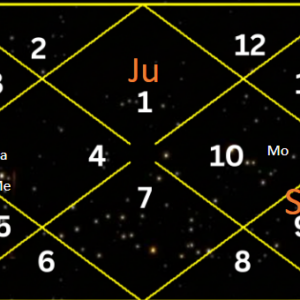
The Panchang—the traditional Hindu astronomical almanac—is often viewed simply as a calendar for religious festivals and auspicious timings (muhurtas). However, beneath its ritualistic surface lies a sophisticated, highly empirical system of celestial mechanics. Far from being based on arbitrary superstition, every single component of the Panchang is rooted in precise mathematical ratios and the relative visual motion of the Earth, Sun, and Moon.
Festivals are not decided arbitrarily either, they are also based on how the quality of a particular time during the year can impact all of us collectively. Let us try to understand the Shraadh paksh and see what is the quality of time or mahurat we get every time of the year when Shraadh paksh is observed.
3 Primary source of energy for an individual.
In a horoscope, be it a natal birth chart or any transit time when we want to do a particular work, there are 3 sources from which we get light and energy from the stars. These 3 sources are

These 3 are the primary sources of light for a horoscope and must be considered to evaluate the quality of the time of birth chart or of transit chart.
Sun
The following are important points to remember while evaluating if the Sun is positive at any particular time
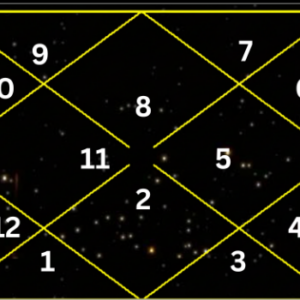
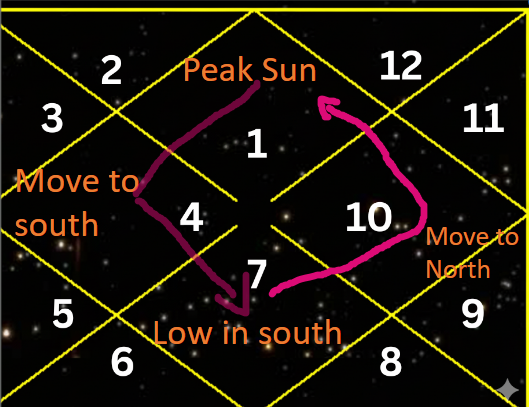
- Houses where the Sun changes direction are the movable signs ( 1 -4-7-1 0).
- -In Aries (Mesh ♈ / Mar–Apr), the Sun is exalted and at the peak of its energy in Cancer (Karka ♋ / Jun–Jul), the Sun starts moving downwards to the south and starts getting weaker day by day till it reaches its lowest in Libra (Tula ♎ / Oct–Nov);
- -from Libra (Tula ♎ / Oct–Nov), the Sun starts moving upwards, and finally,
- in Capricorn (Makara ♑ / Jan–Feb), it changes direction and starts moving upward north
- From the month of Ashwin (September – October), specifically when the Sun leaves its mool trikon Leo (Simha ♌ / Aug–Sep) and moves to Virgo (Kanya ♍ / Sep–Oct), the Sun becomes particularly weak, and our mahurat in general has less energy from the Sun.
- you can learn in detail about sun’s movement from the following article https://learnwithneeraj.com/astrology/vedic-astrology/movable-fixed-dual-zodiac-signs-sun-energy
Evaluating Moon
The following are important points to remember while evaluating if the Moon is positive at any particular time
- Moon reflects the energy from the Sun; thus, if the Sun is weak, this means the Moon is automatically weak. This means the Moon, in general, is weak when the Sun is going south, especially after moving to virgo sign in the month of Ashwing (Ashwin / September – October)
- Moon gets stronger day by day in Shukla Paksha and reaches its peak strength during poornmashi
- Moon gets weaker day by day during Krishna Paksha and is completely combust during amavasya, thereby providing no energy.
The following are important points to remember while evaluating if the Lagna is positive at any particular time
- Ascendant or lagna is the star rising in the east at any given moment. Due to the tilt of the Earth, any star here would provide energy.
- As stars also reflect light from the Sun, the general weakness of the Sun would also impact the strength of the ascendant
- The ascendant would be stronger during the day, as the Sun is stronger during the day.
Basics of Mahurat.
There are 30 mahurats in a day, of which 1 5 belong to the day and 1 5 to the night.
The first mahurat of the day is at the sunrise, when the Ascendant coincides with the Sun
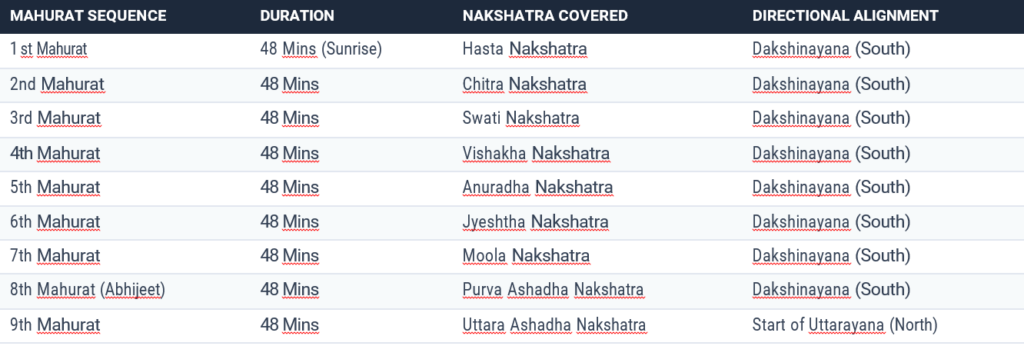
Ascendant covers approximately 1 nakshatra in 1 mahurat, that is 48 minutes ( this is generally called a 2 ghati or simply mahurat, besides there is chaughadiya mahurat which coincides with rashi and is a broader time period that 2 ghati mahurat)
Thus, let us see what happens during the month of Ashwini (September – October) when the Sun is in Virgo (Kanya ♍).
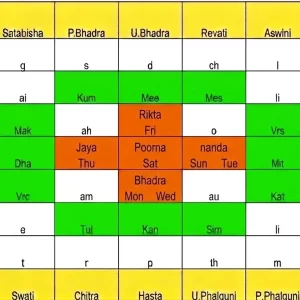
Let us say the sunrise is in Hasta nakshatra, and thus the first lagna, or first Mahurat, is Hasta
more details about sarvatro bhadra chakra and checking mahurat watch the following video- https://youtu.be/8qZ-rBTLNPY
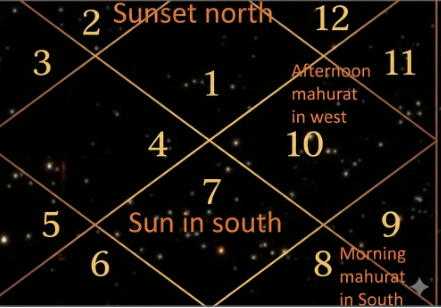
And so on. The thing to notice here is that all the first 9 mahurats of the day during the month of Ashwin (September – October) fall in Dakshinayana. U Ashadha is the start of Uttaraya. Thus, not only is the Sun weak during the month of Kartik (October – November), but also more than half of the mahurats of the daytime are not positive. The remaining 6 mahurats are also slightly better, as they are also not anywhere near eastern horizon.
Thus lagna is general is week during daytime of month of Ashwin as all the morning mahurat falls in the south direction.
Energy from moon
We have seen that the moon is stronger in shukl paksha and weak during krishn paksha. A month of Ashwin (September – October) starts. The moon starts getting weaker day by day till it reaches its lowest during Amavasya of Ashwin month, which is the culmination of Shraadh as sarvpittr shraadh.
Thus, during Shraadh Paksh, the 3 major sources of energy for the horoscope required for a good quality of time (good mahurat) are negative.
Sun is going south, moving to debilitation
Lagna during the day all fall in the south direction, limiting the already reduced light of the Sun. Moon is in the dark half, also devoid of energy.
All these factors make the first 15 days of Ashwin (September – October) a poor mahurat for any beneficial work to start; hence, our seers thought it wise to abstain from any positive activity during these times and observe them as a time to remember ancestors gone by.
What happens after Pitr Paksh
Navratri starts after Shraddha Paksh. ending in Vijayadashmi on the 10th day of the Shukla Paksha. Here, at least the moon is getting stronger, so the timing is getting better. After 20 days of Vijayadashmi, Diwali is celebrated. After completing 15 days of Krishna Paksha, on the Amavasya of Kartik month (October – November).
Sun is going further down and moon is also in dark phase but the Lagna is now for most part of the day is not in south, As the Sun is now in Chitra or Swati after 3 hours of sunrise all the Muhurats are in Uttarayan and hence positive. The time till Diwali is still highly malefic, though, and to avoid mental issues like depression and phobias which may arise due to lack of energy from the stars, community assembly is promoted, and the festival of Diwali is celebrated at the debilitation point of the Sun at Kartik Amavasya in the grandest of community gatherings to protect the individual’s health,
to learn about Mahurat, Panchang, and various real life Astrology from Astrologers in practice for decades visit- www.cosmicnavigators.com
Summary-
Enjoyed this article?
Get notified when the next one is published.
We send one email per new article — no spam, unsubscribe any time.
⚠️ Disclaimer: The information provided on LearnWithNeeraj.com regarding Astrology, Numerology, and other topics is for educational and guidance purposes only.
Not Professional Advice: This content should not be used as a substitute for professional medical, legal, or financial advice. Always consult a certified professional for specific concerns.
Guest Authors: This site features articles by various contributors. The views and interpretations expressed are those of the individual authors and do not necessarily reflect the views of the website administrator.
Your destiny is in your hands. Use this information as a map, not a mandate.