Nakshatras: The Real Vedic Astrology- Part 2
Nakshatras are the foundation of Rashis and Original Vedic astrology relied on nakshatras and not rashis and bhavas, as we have seen in the last article. ( To read the full article click https://learnwithneeraj.com/astrology/vedic-astrology/nakshatras-the-real-vedic-astrology-part-1 )
Hence to study a native, the stars were identified that represented the specific area of life. In this article, we will see which specific nakshatra represents our subconscious mind, so that we can narrow our study to that nakshatra only and not make vague predictions from the 12th house, which in modern usage indicates the subconscious mind and extends to 30 degrees and contains numerous other things.
Predicting from Nakshatra Without Rashi & Bhavas
So how do we predict from Nakshatra without looking at Rashi and bhavas? For this, there are 4 key techniques:
- Navtara Chakra (Tara Bala Chakra): Divides the 27 Nakshatras into nine groups of three, calculated starting from an individual’s Janma Nakshatra (the birth star where the Moon was positioned at birth).
- Suryaat Nakshatra Bindus: Refers to eight key astrological calculation points based on the position of the Sun’s nakshatra in a birth chart.
- Chandrat Nakshatra Bindu: A set of eight highly sensitive points of stars that are calculated in a specific order, starting from the star (Janma Nakshatra) where the moon was located at the time of your birth.
- Inter-Planetary Nakshatra Calculations: Further detailed study of planetary influences can be made by calculating nakshatras from one planet to another planet; this is similar to the study of conjunctions and aspects of Rashis, but more narrowed down to Nakshatra Padas.
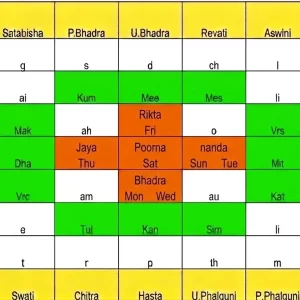
Nakshatra Chakra study is done using the Sarvatrobhadra chakra. you can learn the basics of Sarvatrobhadra chakra from the following video https://youtu.be/8qZ-rBTLNPY
The 8 Sensitive Nakshatra Bindus (Chandrat Nakshatra Bindu)
These eight points correspond to specific positions following the Moon’s constellation:
| Sensitive Site Name (Bindu) | Order of Moon & Constellations | Core Symbols & Life Themes |
|---|---|---|
| 1. Karma | The 10th constellation | Work and behavior: Influences career and job stability or whether one is doing useless work. |
| 2. Sanghaatik | The 16th constellation | Teamwork: This involves collective cooperation, social relationships, and anxieties stemming from the mother. |
| 3. Uday | The 18th constellation | Rising fortune: Symbolizes an upward trajectory in destiny. If it falls in a favorable position, friends or children will become benefactors. |
| 4. Aadhaan | The 19th constellation | Hidden potential: Represents late-blooming consequences that are quietly growing but have not yet surfaced. |
| 5. Vinash | The 23rd constellation | Destruction and transformation: Usually associated with the breakdown of partnerships, marital turmoil, or the end of something. |
| 6. Maanas | The 25th constellation | Mind and Memory: Governs deep-seated imprints, sentimental emotions, and psychological burdens. |
| 7. Raj | The 26th constellation | Royal power and pleasure: Related to worldly riches, luxury, or a kind of deprived pleasure. |
| 8. Abhishek | The 27th constellation | Public honors: Represents social recognition, awards, achievements, and selfless contributions. |
In this article, we try to understand the Manas Nakshatra, representing the working of our subconscious mind.
Understanding Manasa Nakshatra (The 25th Star)
The 25th Nakshatra counted from your birth Moon Nakshatra (Janma Nakshatra) or your Ascendant (Lagna) in Vedic astrology is called the Manasa Nakshatra (or the “star of the mind”) and relates to your subconscious mind and unknown patterns, fears, and anxieties.
Calculation Methods
Manasa Nakshatra is the 25th Nakshatra from the Moon or Ascendant (whichever is stronger); it can be calculated either by:
- Forward Count: Count 25 Nakshatras starting from your Moon’s Nakshatra (treating your own birth star as number 1).
- Reverse Shortcut: Alternatively, count 4 positions backward from your birth Moon Nakshatra.
Manasa Nakshatra mapping by Planetary Lordship
Here is a list of your Manasa Nakshatra, considering your Janma Nakshatra as the one with lordship of:
| Janma Nakshatra Planetary Lord | Manasa Nakshatra Planetary Lord |
|---|---|
| Ketu Nakshatra (Ashwini, Magha, Mula) | Jupiter Nakshatra (P. Bhadrapada, Punarvasu, Vishakha) |
| Venus Nakshatra (Bharani, P. Phalguni, P. Ashadha) | Saturn Nakshatra (U. Bhadrapada, Pushya, Anuradha) |
| Sun Nakshatra (Krittika, U. Phalguni, U. Ashadha) | Mercury Nakshatra (Revati, Ashlesha, Jyeshtha) |
| Moon Nakshatra (Rohini, Hasta, Shravana) | Ketu Nakshatra (Ashwini, Magha, Mula) |
| Mars Nakshatra (Mrigashira, Chitra, Dhanishta) | Venus Nakshatra (Bharani, P. Phalguni, P. Ashadha) |
| Rahu Nakshatra (Ardra, Swati, Shatabhisha) | Sun Nakshatra (Krittika, U. Phalguni, U. Ashadha) |
| Jupiter Nakshatra (Punarvasu, Vishakha, P. Bhadrapada) | Moon Nakshatra (Rohini, Hasta, Shravana) |
| Saturn Nakshatra (Pushya, Anuradha, U. Bhadrapada) | Mars Nakshatra (Mrigashira, Chitra, Dhanishta) |
| Mercury Nakshatra (Ashlesha, Jyeshtha, Revati) | Rahu Nakshatra (Ardra, Swati, Shatabhisha) |
Important Note:
In the above calculations, we have said that for Ketu Nakshatra, Jupiter Nakshatra is the Mansa Nakshatra, and so on; however, we must always consider it based on Nakshatra qualities, like for Ashwini Nakshatra, P. Bhadrapada is the Mansa Nakshatra, and for Magha, Punarvasu is the Manasa Nakshatra.
Using Planet deities of vimshottari dasha system is a simplification and we must always remember the Nakshatra deities and characteristics.
What Manasa Nakshatra Represents
- The Inner Fortress of the Mind: While your birth Nakshatra shows your immediate emotional nature and outer personality, the 25th Manasa Nakshatra reveals the deeper, hidden workings, subconscious fears, and psychological patterns of your mind.
- Testing and Transformation: It often points to life periods where your mental endurance, patience, discipline, or ability to surrender/let go are tested. This would happen during transit periods for this nakshatra.
- Ending and Renunciation: Themes associated with the 25th star include major transitions, sacrifice, and learning how to handle crisis or emotional turbulence without breaking down.
Practical Example: Vishakha Native
Let us Consider the following example of a native with Vishakha Nakshatra.
For Vishakha Natives, Hasta is the Mansa Nakshatra.
Vishakha represents the immediate emotional nature and outer personality; Hasta represents the subconscious, deeper, hidden workings, subconscious fears, and psychological patterns of your mind.
Now we must know the characteristics of both the Nakshatras to create a picture of the native:
- Vishakha is an achievement-oriented, mixed nakshatra which can be soft or harsh. It represents a desire to achieve victory. The deities are Indra and Agni.
- Hasta Nakshatra represents a social nature, becoming independent by use of skill and living a socially balanced life.
- Thus, the native may be aggressive in achieving in his objectives, as his current state of mind and emotions push him towards goals, but his mind would repeatedly wander towards having a socially balanced and independent life.
- This pattern could be further aggravated if Mansa Nakshatra is occupied by any planet.
- If the planet occupying the Manasa nakshatra is malefic, it would give anxiety, delusions, and a feeling of restlessness.
- If planets occupying Mansa Nakshatra are benefic, the native would have a peaceful mind without distractions and can focus on the current task.
The characteristics of Mansa Nakshatra come from the past life and represent subconscious thoughts and fears.
Impact of Planetary Transits
25th Nakshatra from any planet would fall in its 12th house and specifically in the starting 3 degrees 20 minutes of the 12th house. If any planet is positioned in this area then only then can we say that it will have an impact on the subconscious mind. If the planet is in the 12th house but not in the first 3 degrees 20 minutes, then it is not the 25th star and does not have an impact on subconscious mental patterns.
When malefics like Saturn-Rahu-Ketu transit the Mansa nakshatra, or during the Dasha-antardasha period, it creates unknown anxiety, fears, and phobias.
In the next articles, we will see other sensitive points from the Moon, Sun, and other planets.
Summary
Article Summary: Ancient Vedic astrology pinpoints exact psychological patterns using Nakshatra Bindus rather than broad 30-degree zodiac houses. The 25th star from your Moon (Manasa Nakshatra) governs your subconscious fears, past-life mental imprints, and inner stability. While your Janma Nakshatra dictates your outer personality, Manasa Nakshatra reveals what lies beneath the surface—especially during planetary transits and Dasha periods of malefics like Saturn, Rahu, and Ketu.
Enjoyed this article?
Get notified when the next one is published.
We send one email per new article — no spam, unsubscribe any time.
⚠️ Disclaimer: The information provided on LearnWithNeeraj.com regarding Astrology, Numerology, and other topics is for educational and guidance purposes only.
Not Professional Advice: This content should not be used as a substitute for professional medical, legal, or financial advice. Always consult a certified professional for specific concerns.
Guest Authors: This site features articles by various contributors. The views and interpretations expressed are those of the individual authors and do not necessarily reflect the views of the website administrator.
Your destiny is in your hands. Use this information as a map, not a mandate.