📌 TL;DR
An agentic data platform presents security challenges that traditional perimeter defence does not address. Agents act autonomously, make decisions with real consequences, and have access to sensitive financial data. The zero-trust model — never assume trust, always verify — is the appropriate security architecture. This article covers authentication, authorisation, encryption, agent identity management, GDPR and SOX implementation, and how OPA serves as the enforcement layer for data access control.
⏮️ Previous: Part 10 — Testing the Untestable: Strategies for Agentic System Validation → | ⏭️ Next: Part 12 — The Intelligence Layer: Multi-Agent Orchestration with LangGraph →
📖 Series context: In Part 10 — Testing the Untestable, we validated the platform with unit, integration, property-based, and chaos testing — including chaos tests that verified OPA’s fail-closed behaviour. Now we build the security layer that makes those failure modes the right ones: zero-trust architecture with Kubernetes RBAC, OPA agent authentication, column-level PostgreSQL grants, AES-256 field encryption, and GDPR/SOX controls embedded in the data model. In Part 12 — Multi-Agent Orchestration, these security boundaries become the policy walls that keep coordinated LangGraph agents within their authorised scope.
💡 Quick stats: 🔒 3 security layers — Kubernetes RBAC, OPA policy, PostgreSQL column grants · 🔐 AES-256 application-layer encryption for PII fields, separate from storage encryption · 🛡️ 6 OWASP Top 10 categories addressed with specific platform controls · 📋 5 ISO 27001 Annex A controls mapped to implementation
📖 In This Article
⚠️ Why Traditional Security Falls Short
If you are a data engineer or security architect building a platform where AI agents make autonomous decisions against sensitive financial data — this section explains exactly why the perimeter security model fails for agentic systems. You will understand the two unique threat vectors agentic systems introduce, why zero-trust is the only viable architecture, and what that means concretely in terms of Kubernetes RBAC, OPA policy, and PostgreSQL role design.
Agentic platforms break the perimeter model in two ways:
Agents are inside the network by definition. An agent running in a Kubernetes pod has network access to PostgreSQL, Kafka, MinIO, and OPA. If the agent is compromised — through prompt injection, model poisoning, or a logic error in the workflow — it has full access to all these services unless explicit controls restrict it.
AI decision-making is opaque. Traditional software does exactly what it is programmed to do. An LLM-backed agent makes decisions based on patterns learned from training data, which are not fully interpretable. An agent that appears to behave correctly in testing may behave unexpectedly when presented with novel inputs or adversarial prompts.
Zero-trust security addresses both challenges: every service call is authenticated and authorised regardless of its origin, and agent capabilities are bounded by explicit policy controls that the agent itself cannot override.
↑ Back to top · Next: Zero-Trust Principles in Practice →
🛡️ Zero-Trust Principles in Practice
Zero-trust is not a product — it is an architecture principle with four core tenets:
- 👁️ Never trust, always verify. Every request — whether from a user, an application, or an agent — must be authenticated and authorised before access is granted. A pipeline pod running inside the cluster must present valid credentials to query the database; its network location alone is not sufficient.
- ⚙️ Least privilege access. Every identity (user, service account, agent) is granted only the permissions it needs for its specific function. The pipeline service account can read and write the
staged_datatable. It cannot read theaudit_logtable. It cannot drop tables. - ⚡ Assume breach. Security controls are designed on the assumption that a component will eventually be compromised. The goal is to limit the blast radius: “if an agent is compromised, what is the maximum damage it can cause?”
- 🔍 Explicit verification. Access decisions are made based on identity, device health, data classification, and context — not just network location. OPA is the policy enforcement point for this explicit verification.
↑ Back to top · Next: Authentication and Authorisation →
🔑 Authentication and Authorisation
🏛️ Service-to-Service Authentication
Each platform component has a Kubernetes ServiceAccount with a corresponding RBAC role:
apiVersion: v1
kind: ServiceAccount
metadata:
  name: pipeline-sa
  namespace: agentic-pfm
---
apiVersion: rbac.authorization.k8s.io/v1
kind: Role
metadata:
  name: pipeline-role
  namespace: agentic-pfm
rules:
  - apiGroups: [""]
    resources: ["secrets"]
    resourceNames: ["pipeline-secrets"]
    verbs: ["get"]
  - apiGroups: [""]
    resources: ["configmaps"]
    resourceNames: ["pipeline-config"]
    verbs: ["get", "list"]
The pipeline ServiceAccount can read its own secrets and config maps. It cannot list all secrets in the namespace (which would expose other services’ credentials). This is least privilege at the Kubernetes RBAC layer.
For database access, each service has a dedicated PostgreSQL role with table-level permissions:
-- Pipeline service: can write staged_data, cannot read audit_log
CREATE ROLE pipeline_service;
GRANT INSERT, SELECT ON staged_data TO pipeline_service;

-- Compliance service: can read both tables, cannot write
CREATE ROLE compliance_service;
GRANT SELECT ON staged_data, audit_log TO compliance_service;

-- Analytics service: can read scrubbed data only, never original memos
CREATE ROLE analytics_service;
GRANT SELECT (
    transaction_date, amount, currency, transaction_type,
    scrubbed_memo, audit_metadata
) ON staged_data TO analytics_service;
-- original_memo column is NOT in this grant
The analytics_service column-level grant is how GDPR data minimisation is enforced at the database layer: the analytics team’s service account cannot access the original_memo column, even accidentally.
🤖 Agent Identity
Agents present a unique challenge: they are software components that must authenticate to services, but their execution environment is more dynamic than traditional service accounts. The MCP server (covered in Part 14) provides agent identity management:
- Each agent type has a registered identity in the MCP server
- When an agent invokes a tool, the MCP server validates the agent’s identity before routing the call
- OPA evaluates the agent’s policy — not just “is this agent authenticated?” but “is this agent authorised to invoke this specific tool with this specific parameter?”
class MCPServerAuthMiddleware:
    def validate_agent_request(self, agent_id: str, tool_name: str, params: dict) -> bool:
        policy_input = {
            "identity": agent_id,
            "action": "invoke_tool",
            "resource": {
                "type": "tool",
                "name": tool_name,
            },
            "params": params,
        }
        return self.opa_client.evaluate("agentic/tool_access", policy_input)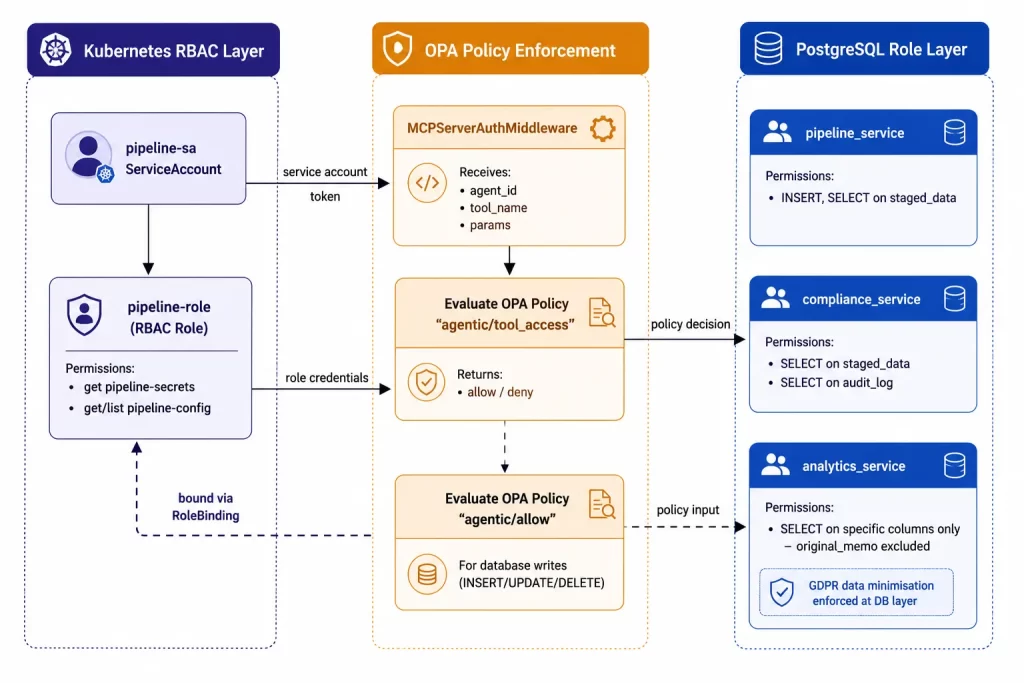
↑ Back to top · Next: Data Classification and Handling →
🗂️ Data Classification and Handling
Not all data in the platform deserves the same protection. The classification scheme maps data sensitivity to handling requirements:
| Class | Description | Examples | Access | Encryption |
|---|---|---|---|---|
| Restricted | Personal data, regulated financial data | original_memo, customer IDs | Compliance team only | AES-256 at rest + in transit |
| Confidential | Business-sensitive, non-personal | amount, transaction_type | Internal teams | Encrypted in transit |
| Internal | Operational metadata | audit_metadata, timestamps | All internal services | Encrypted in transit |
| Public | Non-sensitive operational data | Aggregated metrics | No restriction | Optional |
The original_memo column is Restricted: it contains PII before scrubbing. Access requires the compliance_service role or higher. The scrubbed_memo is Confidential: it has had PII removed, but it is still financial transaction data that must not leave the organisation without authorisation.
🇪🇺 GDPR Implementation
GDPR Article 25 (data protection by design) requires that privacy protections be built into the system architecture, not bolted on afterward. The platform implements GDPR through four mechanisms:
Data minimisation (Article 5(1)(c)): The PII scrubber ensures only the minimum necessary personal data is retained. original_memo is retained under the legal basis of regulatory obligation (SOX Section 802) with a defined retention period; it is not retained for any other purpose.
Retention limits (Article 5(1)(e)): The RetentionStage deletes records that have exceeded their configured retention period. The default retention is 2,555 days (7 years) to satisfy SOX requirements. Records outside this window are automatically purged.
Right of access (Article 15): A data subject can request all personal data held about them. The original_memo column provides the complete transaction history. The query to fulfil a data subject access request is:
SELECT transaction_date, amount, currency, transaction_type, original_memo
FROM staged_data
WHERE original_memo LIKE '%' || $1 || '%'  -- $1 = anonymised identifier
ORDER BY transaction_date;
Right to erasure (Article 17): When a data subject exercises the right to erasure, the original_memo is overwritten with a null value for that subject’s records. The transaction records themselves are retained (SOX obligation outweighs the erasure right for financial records), but the personal identifiers are removed.
📋 SOX Compliance Implementation
SOX Section 404 requires that financial reporting controls be documented, tested, and audited. Section 802 requires a minimum retention period for financial records. The platform satisfies both:
Audit trail: The audit_metadata JSONB column in every staged_data row constitutes an audit trail. Every record carries the batch ID, governance decision, processing timestamp, and pipeline version. An auditor can query the database to verify that every record was processed through the governance stage with an allowed decision.
Segregation of duties: Database roles prevent the pipeline service from modifying the audit_log table. The audit log is append-only (controlled by PostgreSQL row-level security). A developer who has write access to the pipeline code cannot modify audit log entries.
Retention: The 7-year default retention satisfies SOX. The RetentionStage logs every deletion to the audit log before executing, providing evidence that records were retained for the required period before deletion.
↑ Back to top · Next: Encryption →
🔒 Encryption
💾 At-Rest Encryption
All storage systems use encryption at rest:
- PostgreSQL: transparent data encryption via storage-layer encryption (AWS EBS/RDS encryption, Azure Disk Encryption)
- MinIO: server-side encryption for all stored objects
- Qdrant: vector data encrypted at the storage layer
Additionally, the original_memo field is encrypted at the application layer using AES-256 before it reaches the database. This provides defence-in-depth: even if the database storage encryption is compromised, the memo content remains protected:
from cryptography.fernet import Fernet

class MemoEncryptionService:
    def __init__(self, key: bytes):
        self.cipher = Fernet(key)

    def encrypt(self, memo: str) -> str:
        return self.cipher.encrypt(memo.encode()).decode()

    def decrypt(self, encrypted_memo: str) -> str:
        return self.cipher.decrypt(encrypted_memo.encode()).decode()
The encryption key is loaded from an environment variable (ENCRYPTION_KEY) that is injected from the secrets manager at deployment time. It is never stored alongside the data it protects.
🌐 In-Transit Encryption
All service-to-service communication uses TLS:
- PostgreSQL:
sslmode=verify-fullin connection strings - Kafka: TLS listeners with certificate verification
- MinIO: HTTPS endpoint
- OPA: HTTPS
- OpenMetadata: HTTPS
In development (Docker Compose), TLS is optional to reduce setup complexity. In production (Kubernetes), it is mandatory, enforced by a network policy that rejects non-TLS connections.
↑ Back to top · Next: OWASP Top 10 Applied to Data Pipelines →
🛡️ OWASP Top 10 Applied to Data Pipelines
The OWASP Top 10 is typically discussed in the context of web applications, but the attack vectors apply equally to data pipelines:
- A01 Broken Access Control: Addressed by PostgreSQL role-based access control and OPA policy enforcement. Every data access decision is evaluated against policy.
- A02 Cryptographic Failures: Addressed by AES-256 for sensitive fields and TLS for all inter-service communication.
- A03 Injection: The pipeline uses parameterised SQL queries throughout. The
execute_batch()call frompsycopg2.extrasuses parameterised bindings — user data never appears directly in SQL strings. - A05 Security Misconfiguration: Addressed by infrastructure-as-code (Terraform) that enforces security settings declaratively, and by the pre-commit secret scanning hook that prevents credential exposure.
- A07 Identification and Authentication Failures: Addressed by Kubernetes ServiceAccount-based service identity and OPA agent authentication.
- A09 Security Logging and Monitoring Failures: Addressed by the audit log (structured JSONB in every row), OPA decision log, and Prometheus metrics that alert on anomalous access patterns.
↑ Back to top · Next: ISO/IEC 27001 Controls Mapping →
📋 ISO/IEC 27001 Controls Mapping
ISO/IEC 27001 defines an Information Security Management System (ISMS). The platform implements several key controls from Annex A:
| Control | Implementation |
|---|---|
| A.9.4.1 Information access restriction | PostgreSQL role-based column grants, OPA policy enforcement |
| A.10.1.1 Policy on the use of cryptographic controls | AES-256 for sensitive fields, TLS for transit |
| A.12.4.1 Event logging | Audit log embedded in data rows, Prometheus metrics, OPA decision log |
| A.16.1.7 Collection of evidence | Immutable audit trail, retention controls, governance decision log |
| A.18.1.3 Protection of records | Retention policy, append-only audit log |
↑ Back to top · Next: Secret Scanning and Prevention →
🔍 Secret Scanning and Prevention
Secrets accidentally committed to version control are one of the most common security incidents. The platform uses detect-secrets in a pre-commit hook to prevent this:
# .pre-commit-config.yaml
repos:
  - repo: https://github.com/Yelp/detect-secrets
    rev: v1.4.0
    hooks:
      - id: detect-secrets
        args: ["--baseline", ".secrets.baseline"]
The baseline file (secrets.baseline) records known false positives (test fixture values, example configurations). The hook blocks any commit that contains a new string matching credential patterns: API keys, database connection strings, private keys.
In CI, a separate git-secrets or truffleHog scan covers the full commit history and pull request diffs, catching any secrets that bypassed the pre-commit hook.
💡 Pro tip: The most dangerous secret is not one that gets committed intentionally — it is one committed accidentally in a debug session or a test fixture. The detect-secrets baseline file lets you acknowledge known false positives (example values, test fixtures) so the hook stays on without alert fatigue. Set it up before the first commit, not as a remediation step after an incident.
↑ Back to top · Next: Frequently Asked Questions →
❓ Frequently Asked Questions
Common questions about zero-trust security and compliance for agentic data platforms, answered from real-world implementation experience.
What is zero-trust security and how does it apply to data pipelines?
Zero-trust means every request is authenticated and authorised regardless of where it originates. Traditional perimeter security trusts traffic inside the network — but an agentic platform has AI agents inside the network that can be compromised through prompt injection or model poisoning. Zero-trust removes implicit trust: a pipeline pod must present valid Kubernetes ServiceAccount credentials to reach the database; an agent must be evaluated against OPA policy before invoking any tool. Network location is not a credential. This is implemented through three layers: Kubernetes RBAC, OPA tool-access policy, and PostgreSQL role-based column grants.
How do you implement GDPR data minimisation at the database layer?
Use column-level PostgreSQL grants, not application-layer filtering. The analytics_service role is granted SELECT on specific columns of staged_data — explicitly excluding original_memo. This means the analytics team’s service account physically cannot retrieve the PII column, even if a developer writes a SELECT * query by mistake. Application-layer filtering can be bypassed; a database-layer column grant cannot. This satisfies GDPR Article 25 (data protection by design) because the minimisation is enforced at the storage layer, not as documentation.
How do you prevent secrets from being committed to a Git repository?
Pre-commit hook scanning with detect-secrets, backed by CI history scanning. The pre-commit hook checks every staged file against known credential patterns (API key formats, connection string patterns, private key headers) before the commit completes. A .secrets.baseline file records known false positives so the hook does not block test fixtures. In CI, truffleHog or git-secrets scans the full commit history and PR diffs, catching anything that bypassed the pre-commit hook. The two-layer approach catches both new commits and historical exposure.
How does OWASP Top 10 apply to data pipelines differently than to web applications?
The attack categories are the same; the implementation surface differs. A03 Injection in a web app means SQL injection via form fields; in a data pipeline it means injection via transaction memo fields processed by the PII scrubber — addressed with parameterised SQL in every execute_batch() call. A01 Broken Access Control in a web app means missing auth middleware; in a pipeline it means an agent accessing a data column it should not — addressed with PostgreSQL column grants. The mitigations map directly; the threat actors target the same vulnerability classes through different entry points.
↑ Back to top · Next: Key Takeaways →
🔑 Key Takeaways
- Zero-trust means every request is authenticated and authorised regardless of network origin — agent location inside the cluster is not a security credential; a compromised pod must not be able to reach services it has no business accessing.
- Column-level PostgreSQL grants implement GDPR data minimisation at the database layer — not just as documentation, but as an enforced control; the analytics service account cannot access
original_memoeven accidentally. - Application-layer AES-256 encryption for sensitive fields provides defence-in-depth — using a separate key from database storage encryption ensures that a storage-layer compromise does not expose memo content.
- OWASP Top 10 vulnerabilities — injection, broken access control, misconfiguration — apply to data pipelines as much as to web applications — map them explicitly; parameterised SQL, role-based grants, and Terraform-enforced configuration address them systematically.
- SOX segregation-of-duties requires that the pipeline service cannot modify its own audit trail — append-only audit log with separate role permissions enforces this; a developer with pipeline code access cannot alter audit log entries.
- Secret scanning in pre-commit hooks and CI prevents the most common class of credential exposure incidents —
detect-secretswith a maintained baseline blocks accidental commits; CI scanning covers the full history.
🙏 Thank You, Reader
Thank you for reading. Zero-trust security is one of those topics where the principles sound obvious but the implementation details are where the real work lives — column-level grants, application-layer encryption, and agent identity management each require deliberate design choices. The next article moves into multi-agent orchestration with LangGraph, where these security boundaries become the walls that keep coordinated agents within their authorised scope.
📫 Connect With Me
- 💼 LinkedIn: Connect with me on LinkedIn
- 💻 GitHub
Enjoyed this article?
Get notified when the next one is published.
We send one email per new article — no spam, unsubscribe any time.
⚠️ Disclaimer: The information provided on LearnWithNeeraj.com regarding Astrology, Numerology, and other topics is for educational and guidance purposes only.
Not Professional Advice: This content should not be used as a substitute for professional medical, legal, or financial advice. Always consult a certified professional for specific concerns.
Guest Authors: This site features articles by various contributors. The views and interpretations expressed are those of the individual authors and do not necessarily reflect the views of the website administrator.
Your destiny is in your hands. Use this information as a map, not a mandate.