TL;DR
This article details the foundational stage of building a modern API, moving from a simple idea to a robust microservices architecture. We explore the critical architectural decisions made on day one, such as choosing microservices over a monolith, creating a shared code library to stay DRY, and implementing proactive security. We highlight how partnering with an AI coding assistant transformed these complex, time-consuming tasks into a rapid and efficient design process, allowing us to build a production-ready foundation in hours, not weeks.
The Spark: An Idea Meets a Modern Development Workflow
Every developer knows the feeling: a great idea for an application sparks in your mind. The immediate urge is to open a single file and start coding. But what happens when that simple idea needs to grow? How do you build a foundation that can scale without collapsing under its own weight?
This series documents the real-world journey of building a backend API, starting from just an idea: an on-demand data processing engine. Our objective was to create a service that could accept user data, perform complex calculations, and instantly return a customized PDF report.
However, our real objective was to build it right. This meant embracing modern software engineering principles from the very beginning. In the traditional software development life cycle i.e. without a supporting AI co-pilot, this would have involved weeks of research, debate, and trial-and-error. Today, we have a new tool in our arsenal: an AI coding assistant. This is the story of how a human software developer and an AI co-pilot collaborated to architect, design, and build a scalable, cloud-native application from the ground up.
Architectural Pillar #1: Microservices Over Monolith (An AI-Guided Decision)
The first and most critical decision was to reject the monolith. A monolithic application, where all code lives in a single, tightly-coupled codebase, is easy to start but becomes exponentially harder to maintain, scale, and update.
Instead of falling into this trap, we had a design conversation with our AI assistant. Please note that this is an illustrative and indicative prompt. In the real world scenario, you will have to be more descriptive.
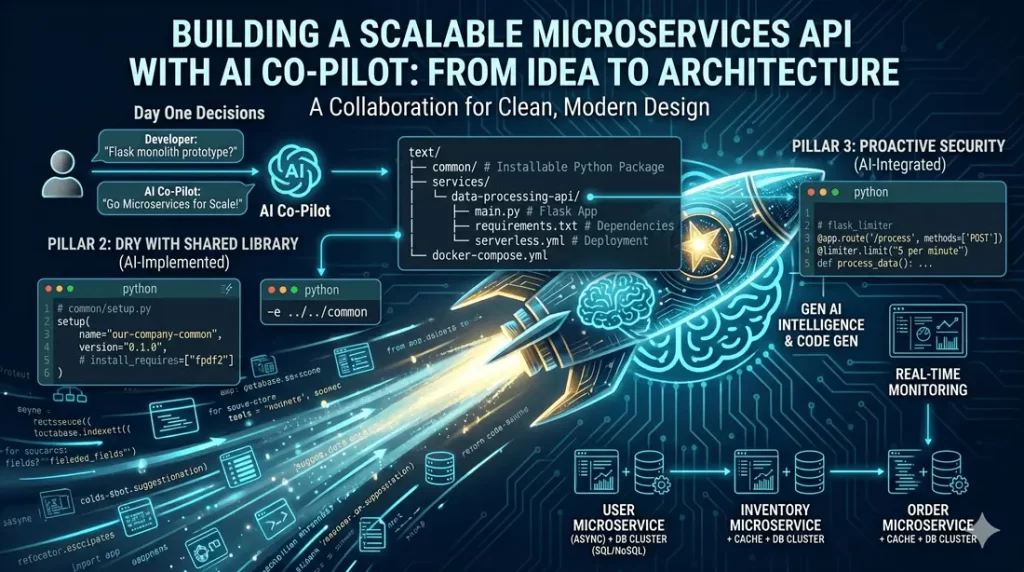
Developer: “I need to build this data processing API. Should I just put it all in one Flask app?”
AI Assistant: “That’s a valid start for a prototype. However, for a scalable system, I recommend a microservices architecture. This will allow you to develop and deploy new features independently in the future without impacting your existing code.”
Guided by this advice, a clean, multi-service project structure was established.
text/
├── common/                 # A home for code shared by all services
├── services/
│   └── data-processing-api/  # Our first, isolated microservice
│       ├── main.py             # The Flask application itself
│       ├── requirements.txt    # Service-specific dependencies
│       └── serverless.yml      # Deployment configuration
└── docker-compose.yml      # For running our local test environment
This structure, recommended and scaffolded by the AI, provided immediate benefits. Our data-processing-api is a self-contained unit. When we’re ready to add a user-profile-api or a billing-api, we’ll simply create new folders under services/. Each service can have its own database, its own dependencies, and its own deployment lifecycle. This is the essence of scalable design, implemented on day one.
Architectural Pillar #2: The DRY Principle with a Shared Library (AI-Implemented)
A common challenge with microservices is handling shared functionality. For instance, multiple services might need to generate PDFs or connect to the same authentication system. Copying and pasting this code is a recipe for disaster; a bug fix in one place would have to be manually replicated everywhere else.
This is where the “Don’t Repeat Yourself” (DRY) principle comes in. The AI assistant proposed and helped implement a professional solution: a shared local library.
The common/ directory isn’t just a folder of scripts; it’s a proper, installable Python package. The AI generated the crucial setup.py file that makes this possible.
python# <script.py>
from setuptools import setup

setup(
    name="our-company-common",
    version="0.1.0",
    description="Shared utility code for our microservices.",
    py_modules=["utils"], # Exposes utils.py as an importable module
    install_requires=[
        "fpdf2==2.7.5", # Dependencies of the shared code live here
    ],
)
With this in place, each microservice can simply include the shared library in its own requirements.txt. The AI suggested using the -e flag for “editable” mode, a pro-tip for local development.
pip# <path to > requirements.txt

# Service-specific dependencies
flask==3.0.0
a-specific-data-library==0.1.2

# Install the local shared library in editable mode
-e ../../common
When we run pip install -r requirements.txt, pip installs our common package. Because of the -e flag, any changes we make in the common directory are instantly available to the service without a reinstall. This is a sophisticated setup that the AI made trivial to implement.
Architectural Pillar #3: Proactive Security (AI-Integrated)
Security is not an afterthought. In the early stages, it’s easy to forget about vulnerabilities. Our API’s data processing endpoint is computationally intensive, making it a prime target for a Denial of Service (DoS) attack. A malicious actor could flood it with requests, overloading the server and taking our service offline.
We tasked our AI co-pilot with securing the endpoint. It immediately integrated the flask-limiter library.
python# <path>\main.py
from flask_limiter import Limiter
from flask_limiter.util import get_remote_address

# ... app initialization ...

limiter = Limiter(
    get_remote_address,
    app=app,
    default_limits=["20 per minute"],
    storage_uri="memory://" # For local testing
)

# Apply a stricter, specific limit to our most intensive endpoint
@app.route('/process', methods=['POST'])
@limiter.limit("5 per minute")
def process_data_api():
    # ... core logic ...
This simple but powerful addition provides a crucial layer of defense. The AI also correctly noted that for a real cloud deployment, the storage_uri should be pointed to a centralized store like Redis, ensuring limits are shared across all auto-scaled instances of our server. This foresight saved us from discovering the vulnerability in production.
The Journey So Far
In what would traditionally take a developer days or weeks of research, planning, and boilerplate coding, we have, in a matter of couple of days, built a robust, secure, maintainable, scalable, extensible foundation for our entire application suite. The AI assistant acted and supported as an experienced architect and a tireless coder, guiding our decisions and implementing best practices instantly.
I would also like to suggest a word of caution for all the fellow developers who have been or planning to use AI co-pilot for speed and other above mentioned benefits. That is don’t trust the AI copilot or companion output blindly. This must be cross validated by you as an expert. During this whole process, I’ve come across a lot of instances where the response was not as good as expected. Despite multiple suggestions, it was not able to correct the response. Then later on, I had to resolve it manually by giving it a “few examples” also known as “few shot” prompt tuning. So, it is always advisable and recommended not to follow the output without a through review.
In our next article, we’ll take this perfectly structured local project and deploy it to the cloud. We’ll explore how we made our application cloud-agnostic and embraced a serverless model to eliminate server management and unlock infinite scalability.
You may directly jump to other parts in this series:
Part 3: The Developer’s Crucible: Debugging, Patience, and the AI Partnership
Part 4: The Case of the Vanishing Images: A Debugging Journey with AI Agents and WordPress
You may like to view other series of 4 part blogs on Building Autonomous AI Agents here.
Enjoyed this article?
Get notified when the next one is published.
We send one email per new article — no spam, unsubscribe any time.
⚠️ Disclaimer: The information provided on LearnWithNeeraj.com regarding Astrology, Numerology, and other topics is for educational and guidance purposes only.
Not Professional Advice: This content should not be used as a substitute for professional medical, legal, or financial advice. Always consult a certified professional for specific concerns.
Guest Authors: This site features articles by various contributors. The views and interpretations expressed are those of the individual authors and do not necessarily reflect the views of the website administrator.
Your destiny is in your hands. Use this information as a map, not a mandate.