TL;DR
A single AI agent cannot safely handle a regulated financial decision. The problem is not capability — it is separation of concerns, auditability, and governance accountability. This article explains why we designed a five-agent system for a banking platform, what each agent is responsible for, and how the Agent-to-Agent (A2A) protocol and Model Context Protocol (MCP) server hold the whole system together. The architecture is not a technology preference. It is a governance requirement expressed as a system design.
Next: The Engineering Platform: Orchestration, Monorepo, and the Stack Decisions
What You Need to Know
- Basic familiarity with what an AI agent is — a system that receives input, reasons, and takes action
- A rough idea of what an API is — one service calling another over HTTP
- No coding knowledge required to follow the architecture concepts
If you are a CTO or architect, you will recognise the domain-driven design patterns immediately. If you are a fresher, everything is explained from first principles.
🩤 The Single-Agent Trap
The most common starting point for AI-powered banking applications is also the most dangerous one: a single large language model that receives a customer request and produces a decision. It seems elegant. The customer asks: “Am I eligible for a home finance product?” The model checks their income, verifies compliance with religious finance principles, assesses risk, and returns an answer. One model. One prompt. One response.
The problem emerges the moment a regulator asks: “How did you arrive at that decision?”
With a monolithic agent, the honest answer is: “The model reasoned about it.” That answer does not satisfy an auditor. It does not satisfy a compliance officer. It does not satisfy a compliance board, an EU AI Act (European Union Artificial Intelligence Act) conformity assessment, or an FCA (Financial Conduct Authority) Senior Managers accountability review. In regulated finance, every decision must be decomposable — traceable to a specific rule, a specific policy, and a specific named actor responsible for that rule.
The accountability gap is not the only problem. There is also a fairness gap. When a single model simultaneously handles credit scoring, domain compliance (whether fair-lending rules, suitability obligations, or religious finance principles), and risk assessment, it is impossible to verify that each of those three concerns is being evaluated by the appropriate standard, with the appropriate oversight, against the appropriate data. A decision that is acceptable from a credit perspective may violate a compliance requirement, and vice versa. Entangling multiple governance concerns in a single model output makes it impossible to audit any of them cleanly.
A monolithic AI agent in regulated finance is not just an architecture risk — it is a governance failure by design. If you cannot explain the decision at the component level, you cannot defend it to a regulator, correct it fairly, or hold any specific system component accountable for it.
There is a third problem beyond accountability and fairness: conflicting objectives that require independent governance paths. A credit decision involves at least three genuinely independent concerns — financial risk (will the customer repay?), domain compliance (does the product structure meet the applicable regulatory or jurisprudential standard?), and regulatory risk (does the transaction flag any sanctions or concentration limits?). These concerns require different expertise, different data sources, and different governing bodies. Forcing a single model to balance all three simultaneously is not just architecturally messy — it produces decisions that cannot be appealed, corrected, or reviewed in parts.
Back to top . Next: Why Regulated Finance Forces Separation
🏛️ Why Regulated Finance Forces Separation
Banking is one of the most heavily regulated industries on earth. Every major financial jurisdiction has model risk management guidelines — the US Federal Reserve’s SR 26-2 (the 2026 update to SR 11-7, extending model risk management to AI/ML systems), the UAE Central Bank’s CBUAE (Central Bank of the UAE) Model Risk Guidelines, the EU’s AI Act (Articles 9–17 for high-risk AI systems), the UK FCA’s AI regulatory framework (Discussion Paper DP18/3, developed through CP24/2), Singapore’s MAS (Monetary Authority of Singapore) FEAT Principles. They all share a common thread: model risk management (MRM) requires knowing exactly what each component of a decision system does, who is responsible for it, and what happens when it fails.
This has profound architectural implications. It means the architecture must be designed to answer these regulatory questions from its structure, not from its logs:
- Separation of duties: The component that evaluates domain-specific compliance (sanctions screening, fair-lending obligations, product suitability rules) must not be the same component that decides credit eligibility. In traditional banking, these are different teams with different sign-off authority. In AI banking, they must be different agents with different governance oversight bodies.
- Independent auditability: A regulator must be able to examine any single decision dimension in isolation. Whether the question comes from a CBUAE examiner asking about a compliance ruling, an FCA supervisory review asking about a risk assessment, or an EU AI Act conformity audit asking about fairness — each must be answerable without untangling the others. If the decisions are entangled in one model output, this is not just difficult — it is structurally impossible.
- Targeted retraining: If the credit scoring model drifts, you retrain the credit agent — not the entire system. With a monolith, every model change touches every governance domain simultaneously, making impact assessment impossible.
- Governance by component: Each governance body has a bounded, named domain — the domain compliance board reviews the compliance agent, the Risk Committee reviews the risk agent, the model risk team reviews the credit agent, regulators examine the orchestrator’s authorization logic. Accountability is not shared ambiguously across the whole system.
- Fairness by domain: Bias monitoring can only be meaningful when applied to a specific decision with specific inputs and a specific outcome. A component that mixes credit eligibility, compliance determination, and risk assessment cannot be subjected to a meaningful disparate impact analysis — under EU AI Act Art.10 or any other fairness framework.
This principle holds across every regulated jurisdiction. MiFID II (Markets in Financial Instruments Directive II) suitability assessment requires expert knowledge distinct from credit risk. MAS TRM Guidelines (2021) require technology risk to be governed separately from business risk. In an Islamic finance context, Sharia compliance is a continuous jurisprudential assessment — novel product structures may have no existing fatwa, and a human scholar must be consulted. Each domain requires its own knowledge base, its own escalation path, and its own governing body. That cannot be expressed inside a general-purpose credit decision model. It requires its own agent.
The NIST AI RMF 1.1 (National Institute of Standards and Technology AI Risk Management Framework) GOVERN 1.2 requirement — that AI system decisions be traceable and explainable — can only be fully satisfied when each decision-making component is clearly bounded, named, and individually auditable. A monolithic agent cannot satisfy this requirement by definition: there is no component boundary to trace to.
Back to top . Next: The Five-Agent Architecture
🏗️ The Five-Agent Architecture
The platform uses five specialised agents, each owning a single bounded governance domain. No agent does the work of another. Each can be governed, audited, updated, and if necessary, suspended independently. The number five is not arbitrary — it maps directly to the five governance domains that a regulated bank must report on separately.
| Agent | Domain | Key responsibility | Governing body |
|---|---|---|---|
| Orchestrator Agent | Workflow coordination | Receives customer request, dispatches to specialist agents, assembles final decision, handles Human-in-the-Loop escalation when any specialist flags uncertainty or a high-risk threshold | Operations / Platform team |
| Credit Agent | Financial eligibility | Computes debt-burden ratio (DBR), retrieves credit score from the Gold data layer, determines Murabaha eligibility by deterministic gate — never by LLM reasoning alone | Credit Risk Committee |
| Sharia Agent | Religious compliance | Validates product structure against AAOIFI (Accounting and Auditing Organisation for Islamic Financial Institutions) Sharia principles, retrieves relevant fatwas via vector search, flags novel structures for Board escalation before any automated approval | Sharia Supervisory Board |
| Risk Agent | Multi-dimensional risk | Assesses seven risk dimensions: DBR, concentration, market exposure, liquidity, operational, country, and FX risk — each domain maps to a regulatory reporting requirement | Risk Management Committee |
| Simulation Agent | Scenario modelling | Models what-if scenarios: rate changes, tenure variations, stress scenarios for portfolio exposure — produces projections, never decisions | Treasury / Modelling team |
Each agent is a completely independent service — its own Docker container, its own Python process, its own API endpoint, its own configuration, its own prompt templates. They share no in-process state. They communicate only through well-defined interfaces. The independence is not just technical. It is the structural expression of the principle that each governance domain has a clear owner who cannot be bypassed by another domain’s logic.
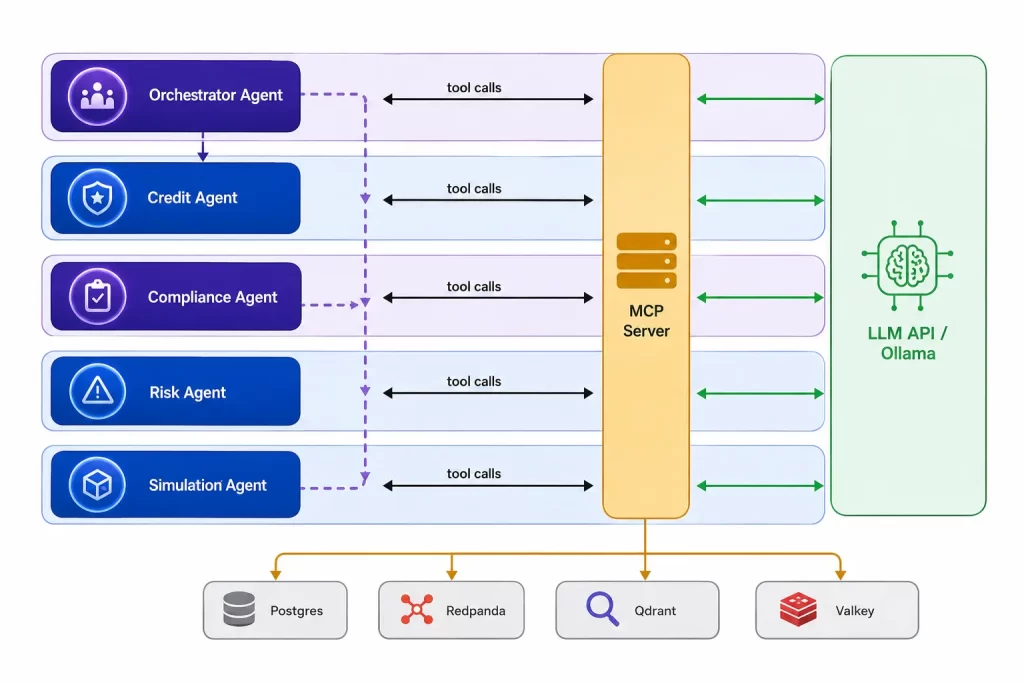
Why five and not three or ten? Five maps directly to the five governance domains that a regulated bank must report on independently. Add agents when you add governance domains, not when you add features. Feature additions go inside existing agents. If a new agent would have the same governing body as an existing one, it probably belongs inside the existing agent, not as a new service.
Back to top . Next: The MCP Server
🔧 The MCP Server: Shared Tools, Not Shared Logic
The five agents need access to common capabilities: credit score lookups from the data pipeline, vector search across the compliance knowledge base, OPA (Open Policy Agent) policy enforcement, PII (Personally Identifiable Information) masking before any LLM call. The naive approach puts these capabilities inside each agent. The correct approach puts them in a single shared service — the Model Context Protocol (MCP) server — where they can be governed once and enforced everywhere.
The MCP server is not an agent. It has no reasoning capability. It is a tool execution layer — a catalogue of named functions that agents can invoke. Think of it as the banking platform’s internal API, purpose-built for AI agent consumption. The governance significance is in what centralisation enables:
- Observation: Without a shared tool layer, each agent would implement its own credit score lookup, its own vector search client, its own OPA policy check. When the credit scoring logic changes, you update five places instead of one. When one of those five implementations diverges, you have five different definitions of “what the credit score means” operating simultaneously.
- Reasoning: Centralising tool execution means centralising tool governance. Rate limits, access controls, audit logging, PII masking — apply once in the MCP server and they apply to every agent that calls it. Controls enforced at a shared boundary are structurally mandatory. Controls inside individual business logic are structurally optional. This distinction is the difference between security by design and security by hope.
- Action: Every shared capability lives in the MCP server. Agents call tools; they do not reimplement them. Every tool call is logged with the calling agent’s identity, the arguments passed, and the result returned. This is the tool-level audit trail that regulators need but that function-call-based architectures cannot provide.
The MCP server exposes tools including: credit_score (retrieves real scores from the Gold data layer, not heuristics), vector_search (semantic search across Sharia fatwas, product catalogue, and customer profiles), sharia_validate (OPA policy enforcement for Sharia structural rules), and pii_mask (Presidio-based data masking before any content reaches an LLM). The pii_mask tool is particularly important: it is available to agents, but it is also enforced as middleware — meaning no tool result that contains PII can be returned to an agent without first passing through the masking layer. Privacy protection is not something an agent opts into. It is something the shared boundary enforces before the agent ever sees the data.
A tool that agents can call is not the same as a tool that is enforced. PII masking as an available tool is an opt-in control. PII masking enforced in MCP server middleware before any tool result is returned is a mandatory control. The architecture must enforce, not offer, when the standard is non-negotiable.
Back to top . Next: The A2A Protocol
🤝 The A2A Protocol: Agents Talking to Agents
When the Orchestrator needs a compliance verdict, it does not call an internal function. It sends an HTTP request to the Compliance Agent’s API endpoint. This is the Agent-to-Agent (A2A) protocol — and the distinction from a simple function call matters enormously for accountability, security, and the independent deployability of each governance domain.
Each agent exposes a standardised discovery endpoint at /.well-known/agent.json. This endpoint returns an Agent Card — a machine-readable description of who the agent is, what skills it offers, what protocol version it speaks, and what its autonomy tier is. Any agent, monitoring system, or human operator can discover another agent’s capabilities at runtime without hardcoded knowledge.
This produces three concrete benefits in a regulated environment:
- Accountability of inter-agent calls: Every A2A call is a network request — it has a timestamp, a request ID, authentication headers, and a response code. The audit trail is structural. With in-process function calls, you have to instrument manually and trust that nobody removes the instrumentation. With A2A, the network boundary is the audit instrument.
- Independent deployment: The Compliance Agent can be updated, restarted, or suspended without touching the Orchestrator. The Orchestrator discovers the current Compliance Agent from the registry and calls its current API. A governance-driven update to compliance logic does not require an Orchestrator deployment, which means the compliance board’s changes stay within the compliance domain.
- Security boundaries that enforce governance: Inter-agent communication is secured at the network boundary — OpenBao authentication tokens per agent, replay protection via HMAC-signed timestamps, and a lateral movement guard that rejects calls from agents that are not in the permitted caller list. A simulation agent cannot call a credit tool. A credit agent cannot call the compliance agent directly. The governance boundaries are enforced by the network layer, not by developer discipline.
The A2A protocol also enables autonomy tier enforcement. An agent registered as SUPERVISED is one whose decisions must have human review before they are acted upon. An agent registered as FULL can act autonomously within its governance boundaries. These tiers are not labels in a database — they are gates enforced by the OPA policy layer that physically block unsupervised action when the tier requires review. The autonomy tier is a transparency instrument: it makes the system’s level of human oversight visible and auditable at any moment.
Back to top . Next: Bounded Context in Practice
📦 Bounded Context in Practice
Domain-driven design’s concept of a bounded context — a clear boundary around a subdomain with its own language, data model, and rules — maps directly onto this agent architecture. Each agent owns its bounded context completely. Nothing outside that boundary can alter how the domain’s rules are applied.
What does this look like concretely? The Credit Agent owns the concept of “eligibility.” Inside the Credit Agent, eligibility means: debt-burden ratio below 45%, credit score above the defined threshold, no active delinquency flag. Outside the Credit Agent, eligibility is just a boolean in the Orchestrator’s state. The Orchestrator does not know how eligibility is computed — and that ignorance is the architecture working correctly.
The Compliance Agent owns the concept of “compliance.” In this platform’s deployment context, that means Sharia compliance — its own fatwa knowledge base, its own compliance rules, its own escalation path to the Sharia Board. In a different jurisdiction it would mean MiFID II suitability rules or FCA Consumer Duty obligations. The Credit Agent does not know what makes a product compliant under the applicable framework — and it cannot be made to behave as if it does, because the compliance domain is physically isolated in a separate process.
This separation produces a counterintuitive result: the system as a whole becomes more transparent and more explainable as complexity increases, not less. Adding a new risk dimension to the Risk Agent does not affect the explainability of the Credit Agent. Adding a new compliance rule to the Compliance Agent does not affect the credit scoring logic. Each bounded context can be explained, governed, and audited in isolation. The complexity is bounded by the context, not accumulated across the whole system.
Technology — Orchestration and Communication
LangGraph
Graph-based agent workflow engine. Each agent’s internal logic is a directed graph of named nodes. Deterministic gates execute first; LLM narrative executes last. The graph topology is the governance artefact.
FastAPI
HTTP framework for each agent’s API surface. Exposes /tasks endpoint and /.well-known/agent.json discovery. Every A2A call is a logged, authenticated network request.
OPA (Open Policy Agent)
Policy enforcement engine. Every agent checks OPA before processing. Deny by default — explicit allow required. Policy changes are hot-reloaded without restart, versioned, and audit-trailed.
OpenBao
Secrets management. Per-agent identity tokens for A2A authentication. Linux Foundation-governed open-source alternative to HashiCorp Vault. BSD 3-Clause equivalent stability.
Redpanda
Event streaming. Agents communicate asynchronously via typed topics. Audit events stream to compliance subscribers. HTTP fallback when broker unavailable — no data loss on transient failures.
Qdrant
Vector search for compliance knowledge base, product catalogue, customer profiles. Apache 2.0, fully self-hosted. Customer vectors never leave the bank’s infrastructure.
Back to top . Next: What We Learned
💡 What We Learned Building This
The architecture described above sounds clean on paper. The reality of building it was messier — and the gaps between the architecture diagram and working behaviour were where the real governance lessons lived. These are not abstract lessons. They are incidents that required rework.
Declaration is not implementation. An agent can be declared in a docker-compose file, have its API endpoint defined, and appear in the service registry — and still not work end-to-end. The compliance agent existed for weeks before we verified that its OPA policy check was actually enforced on incoming requests, not just wired into one internal node. The agent existed. The governance did not. Every integration point — especially every security and compliance integration — needs explicit end-to-end verification, not just code existence.
The vendor-neutral LLM caller is a transparency requirement, not just a convenience. Early versions used a popular LangChain provider package for LLM calls. This created a hidden dependency: the provider’s interface, its error handling, its retry behaviour, its logging — all controlled by a third party we could not audit. We replaced it with a single call_llm() function — a plain HTTP POST using the standard OpenAI-compatible API format. Every token that goes into the LLM and every token that comes out is visible in the Langfuse trace. That observability is only possible because the call is a direct, unmediated HTTP request, not a black-box library invocation.
Prompts belong in versioned files, not in Python code. The first version had prompt strings scattered across Python files. Changing a prompt required finding it in code, testing the change, and deploying a new container. A prompt is the system’s voice in a regulated financial decision. It deserves the same governance treatment as any other code change: version control, peer review, audit trail. Moving every prompt to YAML files made prompt changes reviewable, comparable across versions, and rollback-able independently of the code that uses them.
The license audit is a compliance gate, not a legal nicety. Before writing a line of application code, we audited every dependency for commercial licensing acceptability and data sovereignty implications. Redis: Business Source License 1.1 after March 2024 — vendor-controlled terms, replaced with Valkey. HashiCorp Vault: BSL 1.1 after August 2023 — same concern, replaced with OpenBao. ChromaDB: operational maturity gaps for production banking, replaced with Qdrant. Groq API: customer financial data would leave the bank’s infrastructure in LLM prompts — replaced with Ollama for sensitive inference. A dependency whose terms are controlled by a vendor’s quarterly business decision is a dependency whose compliance posture can change without your knowledge or consent.
Back to top . Next: Key Takeaways
Key Takeaways
- A single agent cannot satisfy regulated finance — not because of capability limits, but because separation of governance accountability requires separation of components. One model, one governing body is not a valid regulatory structure.
- Five agents, five governance domains — Orchestrator, Credit, Sharia, Risk, Simulation each owned by a different governing body. The number of agents is determined by governance structure, not by engineering preference.
- The MCP server enforces, not offers — controls in a shared tool layer are structurally mandatory. Controls inside agent business logic are structurally optional. Privacy, PII masking, and audit logging belong at the enforced boundary.
- A2A over HTTP, not in-process function calls — network boundaries create auditable, securable, independently deployable integration points. The network call is the audit event.
- Autonomy tiers are governance instruments — SUPERVISED and FULL autonomy tiers are OPA-enforced gates, not metadata labels. They make the system’s human oversight level transparent and auditable.
- Declaration is not implementation — every governance integration point requires explicit end-to-end verification. An agent that is declared but whose security controls are not verified is a gap, not a feature.
- Prompts are regulated outputs — a prompt that generates a credit decision narrative deserves version control, peer review, and an audit trail. YAML files, not inline strings.
- License audit before first commit — BSL and vendor-controlled licenses are compliance risks disguised as technical dependencies. A dependency audit is a risk audit.
Thank You, Reader
Whether you are a fresher encountering multi-agent systems for the first time, or a CTO evaluating whether this architecture is right for your regulated platform — thank you for reading. The architecture described here is not the output of a clean design session. It is the result of discovering gaps, reworking integrations, and learning what “production-ready” actually means when regulators, compliance boards, and fairness auditors are in the room. The next article goes deeper into LangGraph specifically: how the graph structure enforces deterministic gates before any LLM reasoning, and why that structural guarantee is the difference between an auditable system and one that merely claims to be.
Connect With Me
- LinkedIn: Connect on LinkedIn
- GitHub: github.com/neerajg5
- Blog: learnwithneeraj.com
Enjoyed this article?
Get notified when the next one is published.
We send one email per new article — no spam, unsubscribe any time.
⚠️ Disclaimer: The information provided on LearnWithNeeraj.com regarding Astrology, Numerology, and other topics is for educational and guidance purposes only.
Not Professional Advice: This content should not be used as a substitute for professional medical, legal, or financial advice. Always consult a certified professional for specific concerns.
Guest Authors: This site features articles by various contributors. The views and interpretations expressed are those of the individual authors and do not necessarily reflect the views of the website administrator.
Your destiny is in your hands. Use this information as a map, not a mandate.