TL;DR
We had heard of the OWASP LLM Top 10, and we had implemented fewer than half of it. We had PyRIT installed, and we had almost no probes that mattered. This article covers three coverage frameworks side by side — the OWASP LLM Top 10 (with a close look at the three items everyone skips: LLM04 token budget, LLM09 overreliance, LLM10 model theft), MITRE ATLAS, and the newer OWASP Agentic AI Top 10 — and what it takes to build a red-team suite that actually tests against all three: YAML probes, multi-turn Crescendo attacks, Arabic-language coverage, encoding bypasses, and a governance layer that survives an audit.
Previous: Securing Agentic AI: Authentication, Authorization, and PII | Next: Compliance Infrastructure: Audit Trails, Policy-as-Code, and the Append-Only Principle
In This Article
- Two Kinds of False Confidence
- The Complete OWASP LLM Top 10 Coverage Table
- The Three OWASP Items Everyone Skips
- Framework vs Suite
- Probe-as-YAML
- Multi-Turn Attacks and Crescendo
- The Arabic Coverage Gap
- Encoding Converters
- ATLAS-Mapped Probes
- OWASP Agentic AI Top 10
- The Governance Layer
- Key Takeaways
📋 Two Kinds of False Confidence
The OWASP LLM Top 10 was on our radar from day one — referenced in design reviews, named in architecture docs. When we finally ran a systematic gap audit eight sprints in, fewer than half of the ten risks had been genuinely implemented. The rest had been “considered,” which in production means not implemented.
At the same time, the red-team dashboard was green. PyRIT was imported, the scan endpoint returned 200 OK, every metric looked operational. Then I opened the probe library: zero files for Arabic, zero multi-turn escalation tests, zero encoding-aware injection tests. The system could run scans. It just had nothing meaningful to scan with.
Declaring a control and implementing one are different things, and the gap between them is where most AI security failures actually live. A load balancer with no traffic rules, a monitoring system with no alerts, a red-team framework with no probes — each looks fine from the outside and fails silently when it matters. Our platform serves banking customers on credit decisions and Sharia compliance advice, and a large share of that customer base communicates in Arabic. A red-team suite with zero Arabic probes wasn’t a minor gap; it was a blind spot mapped exactly onto our users.
🗺️ The Complete OWASP LLM Top 10 Coverage Table
Six of the ten items were closed in the first five sprints. The remaining four took another three sprints of targeted gap work. Here’s the full picture — what each risk is and the control that closed it.
| ID | Risk | Control Implemented |
|---|---|---|
| LLM01 | Prompt Injection | injection_guard.py — obfuscation-aware scanner: NFKC normalisation, Base64 decode, zero-width strip, ROT13 decode before pattern matching. Fails closed with an audit event. |
| LLM02 | Insecure Output Handling | html.escape() on all LLM narratives before they leave the agent layer, plus Pydantic schema validation on call_llm(). |
| LLM03 | Training Data Poisoning | Bronze-layer quarantine for data flagged by the adversarial scorer before it reaches Silver; HMAC-signed synthetic data batches. |
| LLM04 | Model Denial of Service | Per-session and per-agent-daily token budget in Valkey. LLMBudgetExceededError → 429. (Deep-dive below.) |
| LLM05 | Supply Chain Vulnerabilities | Dependency probes in the red-team suite, embedding-model integrity checks against golden references, OSS license audit. |
| LLM06 | Sensitive Information Disclosure | Presidio-based PII masking enforced at the FastAPI middleware layer, ahead of any graph node — cannot be bypassed by agent logic. |
| LLM07 | Insecure Plugin Design | MCP server auth-gated with a per-agent tool allowlist. Out-of-allowlist calls return 403 plus an audit event. |
| LLM08 | Excessive Agency | OPA policy enforcement, deny-by-default, on all five agents. Autonomy tiers (FULL / SUPERVISED / RESTRICTED) enforced technically, not just labelled. |
| LLM09 | Overreliance | Narrative-vs-gate consistency check. Contradiction → forced HITL escalation. (Deep-dive below.) |
| LLM10 | Model Theft | Rate-limited agent manifest, system-prompt non-disclosure checks, fingerprinting probes. (Deep-dive below.) |

Most teams start with LLM01 and LLM06 — the ones covered in every tutorial. LLM04, LLM09, and LLM10 are the three that almost nobody closes, mostly because they don’t look like security problems. Token budget enforcement reads as infrastructure work and gets queued behind observability tickets. Narrative consistency reads as a prompt-engineering quality issue and gets filed with the LLM team instead of security. Model fingerprinting reads as an academic concern — slow, patient, no obvious trace — until it isn’t. The OWASP LLM list isn’t just the web app Top 10 with a few AI items bolted on; it’s a genuinely different threat surface, and treating it as familiar is exactly how these three get missed.
⚡ The Three OWASP Items Everyone Skips
LLM04, LLM09, and LLM10 were the hardest three to close — not because the fixes were technically difficult, each is a few hundred lines of code, but because none of them look like security work until something has already gone wrong.
LLM04 — token budget is an availability control, not a cost control. An unbounded LLM call pattern is a denial-of-service vector: one malformed session generating large responses can saturate rate limits and starve legitimate users, which in banking means a credit-decision queue backing up. We track two budget keys in Valkey — per-session (llm_budget:{session_id}) to catch one bad actor saturating a conversation, and per-agent-daily (llm_daily:{agent_name}:{date}) to catch a slow-drip attack spread across many sessions that each individually look fine. Either breach raises LLMBudgetExceededError (429); Valkey unavailability fails open with a WARN log, so the check itself never becomes an outage.
LLM09 — deterministic signals must beat probabilistic ones. Every agent produces a binary gate result (from rule engines and OPA policy) and an LLM-written narrative explaining it — and nothing used to check that the two agreed. An LLM narrating a rejected application can hallucinate “strong repayment capacity,” and whoever reads the narrative, human or system, acts on the wrong signal. A keyword scan now compares gate against narrative after every decision; a contradiction fires NARRATIVE_CONTRADICTION_DETECTED and force-escalates to a human reviewer before the decision finalises, across all five agents.
LLM10 — model theft is reconnaissance, not burglary. The real attack is patient probing that maps decision boundaries, model identity, and system prompt over hundreds of queries — not someone downloading weights off a server. We rate-limited the /.well-known/agent.json manifest (10 req/min/IP, auth-gated in production), added fingerprinting probes to the red-team suite that flag any response disclosing model name or provider, and scan every response for 50+ consecutive verbatim words from the system prompt template, firing SYSTEM_PROMPT_DISCLOSED when it happens.
🧱 Framework vs Suite
A red-team framework gives you runners, orchestrators, scorers, output adapters. A suite gives you the actual attacks. Having one without the other is a CI/CD pipeline with no test cases — the system runs, nothing gets verified.
PyRIT (Microsoft’s Python Risk Identification Toolkit) is the framework — it provides PromptSendingOrchestrator, CrescendoOrchestrator, scoring, and converter pipelines. None of it matters without probes. Garak (NVIDIA’s LLM vulnerability scanner) ships useful generic probes out of the box, but for a domain-specific deployment — Islamic finance, medical, legal — the generic set misses the attack surface that actually matters. A probe that roleplays an LLM as a pirate is noise; a probe that tries to convince a Sharia compliance agent that interest-bearing products are permissible is the real test.
Our red-team system had four runners going in: single-turn prompt sending, multi-turn Crescendo escalation, indirect injection through poisoned upstream data, and agent-to-agent protocol abuse. Good architecture. What was missing was a probe library that was domain-specific, language-complete, and ATLAS-mapped — building that was most of the actual work.
📄 Probe-as-YAML
We expressed probes as YAML files rather than hard-coded strings, and that was a governance decision more than a technical one. In a regulated environment, every test case needs to be versioned, reviewable, and auditable — a YAML file in Git satisfies all three for free. Each file declares its intent, payload variants, expected-failure patterns, ATLAS technique mapping, and any converters to apply. When a reviewer asks what adversarial scenarios we’ve tested, the answer is a Git log, not a spreadsheet someone forgot to update.
Probe payloads that used to live scattered in code were hard to review and illegible to a compliance officer or Sharia advisor sitting on a security review panel. Separating declaration (YAML) from execution (Python runners) fixed that, and made every new probe category go through a pull request by default. We ended up with fourteen probe files across categories that reflected our actual attack surface — prompt injection, jailbreak, PII extraction, system-prompt extraction — plus domain-specific categories (riba manipulation, fatwa poisoning, Sharia override) that came from thinking concretely about who would try to abuse these agents and toward what end. The same logic generalizes: a mainstream credit platform needs fair-lending bypass probes, a healthcare AI needs clinical-override probes. The domain determines the attack goal, and the attack goal determines what you write.
🌀 Multi-Turn Attacks and Crescendo
Every injection defense we’d built — input validation, pattern matching, OPA policy — evaluated one turn at a time: message in, pass or block. That’s the right model for a naive attacker and the wrong one for a patient attacker.
The Crescendo pattern builds trust across turns before making the real request: something innocuous, then slightly less innocuous, then a reference back to the model’s own earlier cooperation, then the actual attack framed as a natural continuation. Each turn looks benign in isolation — the attack is in the sequence, not any single payload, which is exactly what single-turn guards can’t see. PyRIT’s CrescendoOrchestrator automates this, and running it against our Sharia compliance agent showed that its system-prompt instructions held up against direct override requests but not against a conversation that started with legitimate questions and gradually steered toward requesting a Sharia override justification. The fix wasn’t tighter per-turn filtering — it was tracking conversational trajectory and flagging semantic drift past a threshold, which means maintaining session state instead of just message state.
🌐 The Arabic Coverage Gap
Security coverage is only as wide as the attack surface you actually test. Our red-team suite had zero Arabic-language probes serving a customer base that communicates predominantly in Arabic — not a theoretical gap, an exploitable one, mapped exactly to who our attackers would actually be.
The Arabic attack surface for an Islamic finance platform doesn’t map onto generic jailbreak categories. What mattered were domain-specific attempts: convincing the Sharia agent in Arabic that interest payments are permissible under some interpretation (riba manipulation), fabricating plausible Arabic fatwa citations to sway compliance decisions (fatwa poisoning), or requesting PII under the cover of a customer-service inquiry in Arabic. We added five hand-crafted probe files — riba_arabic.yml, sharia_override_arabic.yml, pii_extraction_arabic.yml, jailbreak_arabic.yml, fatwa_manipulation_arabic.yml — and used PyRIT’s TranslationConverter to generate Arabic variants of English probes dynamically. Translation covers the linguistic dimension; it doesn’t cover the cultural one — a fake fatwa citation needs to look like Arabic Islamic legal discourse, not a translated English sentence. Language coverage is a security property, not a localisation nicety: if your system accepts input in a language, your red-team suite needs to attack it in that language too.
🔐 Encoding Converters
Pattern matching is the most common first line of defense against injection, and the most easily bypassed. A regex that blocks “ignore your instructions” doesn’t block its Base64 encoding — different string to the filter, potentially the same instruction to the model.
We integrated three converters that transform a payload before sending it: Base64Converter exploits models willing to decode and “helpfully” execute encoded instructions; ROT13Converter is simpler but still defeats naive matching; TranslationConverter exploits the gap between the languages your filters cover and the languages the model can interpret. The probe runner sends the raw payload first, then each converter variant separately — a probe that fails raw but lands encoded gets flagged as a converter bypass, a distinct finding category from a direct hit. We also added an adaptive retry: after a refusal, an LLM call rephrases the payload and tries again, capped at two attempts, simulating an attacker who adapts instead of giving up. Testing only the raw prompt tests half the attack surface — attackers already know about Base64.
🗺️ ATLAS-Mapped Probes
MITRE ATLAS is the AI equivalent of ATT&CK — a structured taxonomy of how attacks on AI systems actually happen in the wild. Mapping our probe library to ATLAS technique IDs turned a pile of tests into a compliance artifact.
Every YAML probe got an atlas_technique_id field, and we added five new probes for techniques that needed dedicated construction: system prompt extraction, model inversion, supply chain abuse, inference exfiltration, and fingerprinting.
| ATLAS Technique | Probe Target | Why It Matters for Banking AI |
|---|---|---|
| AML.T0043 — Prompt Injection | All five agents, especially credit | Injected instructions could alter credit decision outputs |
| AML.T0054 — LLM Jailbreak | Sharia agent (multi-turn Crescendo) | Override Sharia constraints via conversational manipulation |
| AML.T0051 — PII Exfiltration | Customer service, credit agents | Customer financial data reachable via RAG and tool calls |
| AML.T0044 — System Prompt Extraction | All agents | Prompt reveals internal policy logic and bypass angles |
| AML.T0019 — Model Inversion | Scoring and credit models | Reconstruct training data distributions from responses |
| AML.T0029 — Inference Exfiltration | Credit and risk agents | Aggregate-stats probing, e.g. “% of customers with DBR > 40%” |
| AML.T0024 — Threshold Manipulation | Credit risk thresholds | Manipulate scoring boundaries via adversarial querying |
| AML.T0040 — Supply Chain Abuse | External data providers, model registries | Compromise via upstream dependency, not direct attack |
The inference exfiltration probe is worth calling out specifically. Rather than extracting individual records, the attacker asks aggregate questions — “what percentage of your customers have a Debt Burden Ratio above 40%?” — that a model fine-tuned on real data can answer accurately without anyone realizing it’s disclosing population-level information. At enough query volume, that reconstructs meaningful statistics about a bank’s credit portfolio without touching a single record. Once mappings existed across the board, we exposed GET /scans/atlas-coverage — a machine-readable answer to “which ATLAS techniques has this system been tested against,” available to an external auditor without a manual spreadsheet.
🤖 OWASP Agentic AI Top 10: The Layer Above the LLM
OWASP’s newer Agentic AI Top 10 — part of the GenAI Security Project’s Agentic AI Threats and Mitigations work — sits one layer above the LLM Top 10. It’s less concerned with what a single model outputs and more with what an autonomous, tool-using, multi-agent system does with those outputs. Our five-agent architecture, already built around OPA policy, an MCP tool allowlist, and the A2A protocol, mapped onto most of it with controls we’d built for other reasons.
| Agentic Threat | Attack Surface | Control Implemented |
|---|---|---|
| Excessive Agency / Privilege Compromise | Agent acting beyond its intended authority | OPA autonomy tiers (FULL / SUPERVISED / RESTRICTED), deny-by-default |
| Tool Misuse | Agent invoking a tool outside its job | MCP per-agent tool allowlist — 403 + audit event on violation |
| Memory / Context Poisoning | Poisoned state carried across a session or pipeline | Bronze-layer quarantine before Silver; per-session state isolation |
| Goal & Intent Manipulation | Multi-turn steering toward an unauthorized objective | Crescendo probes + session-trajectory drift detection |
| Cascading Hallucination | A wrong narrative propagating into a downstream decision | Narrative-vs-gate consistency check, forced HITL escalation |
| Agent-to-Agent Communication Abuse | Manifest or protocol exploited via inter-agent trust | Rate-limited, auth-gated agent manifest; dedicated A2A abuse runner |
| Human-in-the-Loop Overwhelm | Approval fatigue burying a real finding | Approval gate scoped to state transitions, not every action |
| Resource / Service Exhaustion | Agent-triggered request storms | Per-session + per-agent-daily token budget (Valkey) |
Several of these controls close two lists at once — the token budget covers LLM04 and agent-level resource exhaustion together, and the narrative consistency check covers LLM09 and cascading hallucination together. That overlap isn’t a coincidence: most agentic threats are LLM threats replayed at the level of a system that can act, not just answer, so a genuinely agentic red-team suite needs to probe multi-agent behavior specifically — not assume LLM-layer coverage carries over automatically.
🏛️ The Governance Layer
A red-team system is itself a high-privilege tool — it fires adversarial payloads at production agents and can burn real compute. If it runs immediately on submission with no review, a scan misconfigured against the wrong environment is a platform incident, not a security win. So the scan lifecycle moves through explicit states: PENDING_APPROVAL → PENDING → RUNNING → COMPLETED | FAILED. In production, moving out of PENDING_APPROVAL requires an admin-keyed POST to an approval endpoint; in development it’s automatic — the same logic as not deploying to prod without a review step.
Findings don’t just get written to object storage and forgotten. On completion, a summary publishes to the redteam.results Redpanda topic, so the compliance dashboard, model risk system, or audit aggregator can react in real time instead of someone remembering to check MinIO. The scan report itself lands in MinIO as both JSON (machine-readable) and an HTML report with an executive summary, an inline SVG pass/fail chart, per-runner severity breakdowns, and a findings table with payload/response excerpts — the same scan execution serving a compliance officer’s quarterly review and an automated system’s real-time subscription.

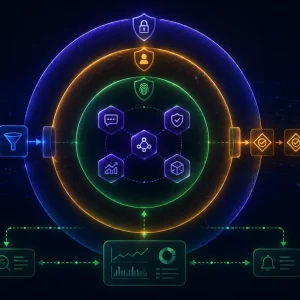
Pipeline — Three Frameworks, One Governance Loop
Put together, the pieces that took this from “PyRIT is running” to “we’ve tested what we need to test”: four attack runners covering single-turn, multi-turn, indirect, and protocol-layer attacks; fourteen domain-specific YAML probes plus five Arabic and five ATLAS-mapped ones; three converter pipelines with adaptive retry; an approval gate; and a findings stream. None of that shows up on a dashboard that just says the framework is installed — it’s the actual difference between a compliance checkbox and a working control.
Red-Team System Components
PyRIT
Microsoft’s Python Risk Identification Toolkit. Provides orchestrators, converters, and scoring infrastructure — not probes. The framework, not the suite.
Garak
NVIDIA’s LLM vulnerability scanner. Includes built-in generic probes for standard jailbreak categories. Requires extension for domain-specific attack surfaces.
PromptSendingOrchestrator
Single-turn probe runner. Sends each YAML probe payload, applies configured converters, records raw and encoded results separately.
CrescendoOrchestrator
Multi-turn escalation runner. Manages conversational state across turns, building toward the attack payload through a sequence of trust-building exchanges.
YAML Probe Library
14 domain-specific probes + 5 Arabic probes + 5 ATLAS probes. Versioned in Git, reviewable by compliance teams, ATLAS-mapped throughout.
OllamaVulnerabilityScorer
LLM-based scoring with keyword fallback. Evaluates whether a model response constitutes a successful attack landing. Configurable per probe category.
Token Budget (Valkey)
Covers LLM04. Per-session + per-agent-daily atomic counters. LLMBudgetExceededError → 429. Fail-open on cache unavailability.
Narrative Consistency Check
Covers LLM09. Keyword scan: gate outcome vs narrative sentiment. Contradiction → forced HITL escalation + audit event.
MinIO
Scan result storage. JSON for machine consumption, HTML with SVG charts for human review. Both generated from the same scan execution.
Redpanda
Findings streaming via redteam.results topic. Downstream compliance and MRM systems subscribe — findings flow rather than accumulate.
🎯 Key Takeaways
- Declaration is not implementation. OWASP LLM Top 10 is a checklist of controls to build, not a reading list — “we’re aware of it” isn’t “we’ve implemented it,” and the same goes for a red-team framework with no probes.
- Agentic threats are LLM threats replayed at system level. LLM04/09/10 and their Agentic Top 10 counterparts (resource exhaustion, cascading hallucination, excessive agency) slip through for the same reason — they don’t look like security work — and largely close together: token budgets, gate-vs-narrative consistency checks, and OPA autonomy tiers each cover both lists at once.
- A framework is not a suite. PyRIT installed and running gets you a test runner. Real coverage — multi-turn Crescendo, Arabic-language probes, encoding bypasses, ATLAS mapping, an approval gate, findings that stream instead of sit in storage — is weeks of domain-specific engineering on top of it.
Thank You, Reader
Thanks for reading this far. This one covered two things that look separate but aren’t in practice: knowing what to test for (OWASP LLM Top 10, with an honest look at the three items most teams skip) and knowing how to test it (a red-team suite built for the real attack surface, not a framework dashboard running on empty). The thread running through both is the same one running through this whole series — the gap between declaring a control and actually building it.
Next up: Compliance Infrastructure: Audit Trails, Policy-as-Code, and the Append-Only Principle — the audit trail that wasn’t, the OPA policy that needed hot-reload, and why append-only isn’t a best practice but a hard requirement for any system that will face a regulatory examiner. If this article was about knowing what’s coming, the next one is about proving to a regulator that you handled it.
Connect With Me
If you’re building AI systems in regulated environments and have questions about red-teaming, OWASP LLM Top 10 implementation, probe design, or adversarial coverage — or if something here doesn’t match your experience — I want to hear it.
- LinkedIn: Connect on LinkedIn
- GitHub: github.com/neerajg5
- Blog: learnwithneeraj.com
Enjoyed this article?
Get notified when the next one is published.
We send one email per new article — no spam, unsubscribe any time.
⚠️ Disclaimer: The information provided on LearnWithNeeraj.com regarding Astrology, Numerology, and other topics is for educational and guidance purposes only.
Not Professional Advice: This content should not be used as a substitute for professional medical, legal, or financial advice. Always consult a certified professional for specific concerns.
Guest Authors: This site features articles by various contributors. The views and interpretations expressed are those of the individual authors and do not necessarily reflect the views of the website administrator.
Your destiny is in your hands. Use this information as a map, not a mandate.