Long before the twelve zodiac signs became synonymous with Indian astrology, skywatchers in ancient India mapped the cosmos through an entirely indigenous lens: the 27 Nakshatras, or lunar mansions. Deeply rooted in Vedic literature and ceremonial traditions, this original system prioritized the Moon’s subtle, psychic influence and the cosmic deities presiding over each stellar realm. However, as trade routes expanded across Eurasia, a profound intellectual exchange began to unfold along India’s northwestern borders.
Between the 2nd and 6th centuries CE, Hellenistic astronomy introduced the solar-based, 12-sign zodiac—the Rashis—into the subcontinent. Rather than discarding their ancestral traditions in favor of foreign methods, classical Indian scholars accomplished an extraordinary feat of synthesis. They aligned the 360-degree solar wheel with the established Nakshatra divisions, and imbued the new horoscopic models with foundational Vedic concepts like Karma and cosmic order.
The Greek system has an advantage in mathematics and calculation, and the Indian system was highly developed in predictive techniques. To understand real Vedic predictive astrology, one must understand all the lunar mansions, or the Nakshatras
1. Historical Timeline and Evolution
Phase I: The Introduction of Classical Rashis (c. 100 BCE – 300 CE)
- Cultural Transmission: The 12-sign solar zodiac—originally conceptualized in Babylonia and later refined in Hellenistic Greece—reached India through trade and cultural exchanges in the northwestern regions (specifically the Indo-Greek and Western Satrap kingdoms).
- The Yavanajataka (c. 269/270 CE): Greek astrological manuals were translated into Sanskrit prose by Yavanesvara and later composed into verse by Sphujidhvaja. The Yavanajataka stands as the earliest surviving Sanskrit text to explicitly outline the 12 Rashis, planetary rulerships, house divisions (Bhavas), and horoscopic charts (Janma Kundali). Originally, horoscopic astrology based on Rashis was a Hellenistic innovation, whereas early Vedic astrology relied primarily on the 27 Nakshatras (lunar mansions) for predictions.
- The Synthesis: Indian scholars adopted Hellenistic horoscopic concepts—including the 12 signs, planetary rulers, house systems, and aspects—and seamlessly wove them into native core principles such as Karma, Nakshatras, and societal classifications.
Phase II: Preservation of Greek Terminology in Sanskrit
As Hellenistic concepts influenced Indian astrological literature (Hora Shastra), ancient scholars chose to transliterate rather than translate many core technical terms, explicitly preserving their Greek origins:
| Sanskrit Term | Greek Original | Meaning / Astrological Context |
| Hora (होरा) | Hōra (ὥρα) | Hour / Horoscopy / Branch of Astrology |
| Dreshkana (द्रेष्काण) | Dekanos (δεκανός) | Decan (10° division of a sign) |
| Kendra (केन्द्र) | Kentron (κέντρον) | Angular Houses (1st, 4th, 7th, 10th) |
| Trikona (त्रिकोण) | Trigonon (τρίγωνον) | Trine / Triangular aspect |
| Panaphara (पणफर) | Epanaphora (ἐπαναφορά) | Succedent Houses (2nd, 5th, 8th, 11th) |
| Apoklima (अपोक्लिम) | Apoklima (ἀπόκλιμα) | Cadent Houses (3rd, 6th, 9th, 12th) |
| Lipta (लिप्ता) | Lepton (λεπτόν) | Arc minute (1/60th of a degree) |
| Anapha / Sunapha | Anaphora / Synaphe | Specific planetary yoga formations |
Phase III: Full Integration into Classical Jyotisha (c. 400 CE – 600 CE)
Rather than discarding their indigenous system, Indian scholars synthesized the 12 Rashis with the traditional Nakshatras:
- Mathematical Alignment: The 360° zodiac wheel was divided into 12 Rashis of 30° each. Each Rashi was systematically mapped to 214 Nakshatras (or 9 Padas / quarters of 3°20′ each).
- Canonical Texts: Treatises like Varahamihira’s Brihat Samhita and Brihat Jataka (6th century CE), Aryabhata’s Aryabhatiya (5th century CE), and the Brihat Parasara Hora Shastra formalized the sidereal (Nirayana) framework. This solidified the dual Rashi-Nakshatra model used in Indian astrology today.
2. Re-Examining Core Concepts Through Traditional Nakshatra Astrology
To understand the core mechanics of original Nakshatra-based astrology, consider how elemental qualities and house significations map directly to Nakshatras rather than just sign boundaries:
Primary Energy Significations
- The Earth Element (Artha Trine): While modern Vedic astrology assigns wealth to Taurus and the 2nd house, the Nakshatra Rohini falls entirely within Taurus (all 4 Padas). Therefore, true material creation and wealth are governed by Rohini. Surrounding Nakshatras like Krittika and Mrigashira signify different facets; for instance, Mrigashira conveys a love for adventure, comfort, and pleasure also associated with Taurus. Notably, the Moon’s Nakshatras—Rohini, Hasta, and Shravana—align with Earth signs (Taurus, Virgo, Capricorn), symbolizing the practical capacity to manifest and create.
- The Air Element: Modern astrology classifies the 3rd, 7th, and 11th houses/signs as Airy. However, this intellectual, airy quality stems from Rahu’s Nakshatras (Ardra, Swati, Shatabhisha), which reside entirely within these signs.
- The Water Element: Emotional and fluid energy in the Water signs (4th, 8th, 12th) originates primarily through the Nakshatras ruled by Saturn and Mercury.
- The Fire Element: The initiating, fiery impulse in the 1st, 5th, and 9th houses belongs to the Nakshatras governed by Ketu and Venus, which sit fully within these signs.
Summary of Element Distribution
- Nakshatras fully contained within a single Rashi (all 4 Padas): Express the purest, unmixed characteristics of that sign.
- Ketu & Venus Nakshatras: Represent the Fiery initiative needed to start actions.
- Moon Nakshatras: Represent the Earthy energy required to execute and build.
- Rahu Nakshatras: Represent the Airy intellectual energy required for thought and reflection.
- Saturn & Mercury Nakshatras: Represent the Watery energy of emotion and depth.
Overlapping Nakshatras & Malefic Energies
Nakshatras belonging to the Sun, Mars, and Jupiter span across sign boundaries. Interestingly, these overlapping Nakshatras often channel more challenging or malefic energies—such as Maraka (death-inflicting potential for the 2nd and 7th houses), loss, illness (6th house), transformations/death (8th house), or hospitalization (12th house).
While the Greeks contributed immense mathematical precision to calculating house divisions and planetary positions, Indian scholars expanded the predictive depth, harmonizing Hellenistic geometry with their rich Nakshatra tradition.
3. How to Study Authentic Indian Predictive Astrology
To master original predictive methods, one must look to foundational sources and specific analytical techniques:
- Textual Sources: The Rigveda contains the earliest references to the Nakshatras, while later texts like the Harivamsa Purana elaborate on their symbolic meanings.
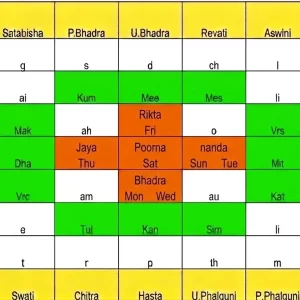
- The Sarvatobhadra Chakra: One of the most powerful diagnostic frameworks in traditional astrology is the Sarvatobhadra Chakra—a 99 grid utilized in Swarodaya astrology. Meaning “auspicious on all sides” (Sarva = all, Bhadra = good), it is used to evaluate transits, life events, commodity prices, and atmospheric forecasts. more can be learned about Sarvatrobhadra chakra from the following link- https://youtu.be/8qZ-rBTLNPY
- Nakshatra Deities over Planetary Lords: The planetary rulers assigned to Nakshatras are primarily tied to specific timing systems like the Vimshottari Dasha. Because different Dasha systems assign different planetary lords to the same Nakshatra, relying solely on planetary lords for core character traits can be misleading. Precise predictive insights come from studying the native Deity (Devata) governing each Nakshatra.
- Navtara Chakra most commonly used for Mahurat is very useful in predictions. how to predict using Navtara chakra can be seen from the following post https://learnwithneeraj.com/astrology/vedic-astrology/navtara-chakra-predict-house-results-without-software-or-panchang
- Sequence in Dasha Interpretation: Evaluating a Dasha requires looking beyond the general ruling planet. Running a Rahu Dasha through Ardra differs significantly from running it through Swati or Shatabhisha. The precise sequence of outcomes unfolds relative to the natal Moon’s position. For instance:
- If the natal Moon is in Ashwini, the native progresses through the Dashas of Ashwini, Bharani, Krittika, Rohini, and so on.
- If the natal Moon sits in Magha, the sequence progresses through Magha, Purva Phalguni, Uttara Phalguni, Hasta, etc.
Each sequence shapes life events uniquely, dictated by the foundational characteristics of the specific Nakshatra journey.
Summary
The evolution of Jyotisha reflects a remarkable period of intellectual synthesis. By integrating Hellenistic solar zodiacs and mathematical frameworks with indigenous, deity-centric Nakshatra wisdom, ancient Indian astrologers created a multi-layered predictive discipline. Modern practitioners who study both the overarching Rashi structures and the foundational Nakshatra deities can access the full breadth of this historical and analytical art.
In next articles we will dig deep into individual Nakshatras and the predictive techniques associated.
Enjoyed this article?
Get notified when the next one is published.
We send one email per new article — no spam, unsubscribe any time.
⚠️ Disclaimer: The information provided on LearnWithNeeraj.com regarding Astrology, Numerology, and other topics is for educational and guidance purposes only.
Not Professional Advice: This content should not be used as a substitute for professional medical, legal, or financial advice. Always consult a certified professional for specific concerns.
Guest Authors: This site features articles by various contributors. The views and interpretations expressed are those of the individual authors and do not necessarily reflect the views of the website administrator.
Your destiny is in your hands. Use this information as a map, not a mandate.